
By Mike Duncan | November 2026
A 2% rise in SOFR would take most of a year’s profit
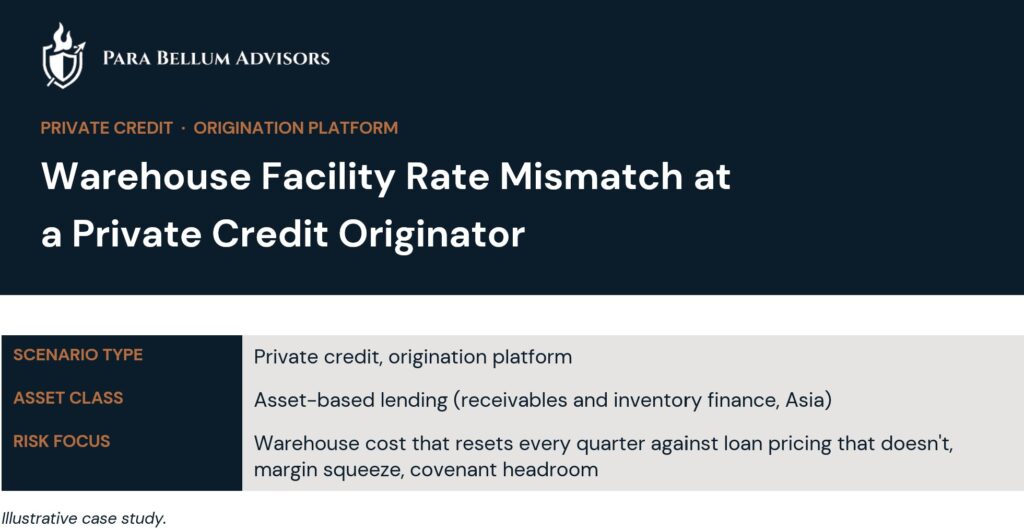
Scenario type: Private credit, origination platform
Asset class: Asset-based lending (receivables and inventory finance, Asia)
Risk focus: Warehouse cost that resets every quarter against loan pricing that doesn’t, margin squeeze, covenant headroom
The Situation
In a quarter of record loan volumes, the board of an Asian asset-based lender asked its CFO what higher rates would do to the business. With SOFR at 4% and forecasters split on where it went next, the CFO ran it 2% higher (200 basis points). Profit before tax would fall from about USD27m a year to about USD7m, even before any rise in credit losses.
The business lent against receivables and inventory, with a book of about USD1.2bn, and it had built that book rapidly. Clients were approved and funded in two to three days, and they paid about 11% for that certainty rather than shopping for the lowest rate. About USD1bn was drawn on average on a bank warehouse facility, at 3-month Term SOFR plus a spread of 2.5%, reset every quarter, with USD200m of equity behind the book. With SOFR at 4%, that produced a pre-tax return on equity of approximately 13.5%, and for several years it looked like a well-run, low-risk business.
Part of the reason it looked low risk was the way the risk reporting looked at the book. It measured interest rate exposure by the loan drawdown maturity, which averaged under four months, and on that view there was very little to hedge. The reporting was accurate about the drawdowns, but the rate for each drawdown was set in the client’s facility agreement and ranged from 12 to 24 months.
How the Risk Shows Up
The warehouse cost moves with SOFR every quarter, while the loan book reprices when client facilities roll, 12 to 24 months later. In between, every rise in SOFR comes straight out of the margin. In effect the business was running a leveraged carry trade, with USD5 of floating-rate funding for every USD1 of equity and assets whose price was fixed for up to two years.
If SOFR rises from 4% to 6%, the warehouse costs roughly USD20m a year more. Income stays at USD132m, funding rises from USD65m to USD85m, and with costs and credit losses at around USD40m, profit before tax falls to an annual run-rate of USD7m, a 3.5% return on equity. It stays at that level until facilities roll and can be repriced.
The Lesson
The drawdowns were short. The pricing on them wasn’t.
Test It on Your Own Numbers
– Set out when your loan pricing resets against when the warehouse does. How long is the gap, and does your risk report measure that gap or the drawdown maturity?
– Run SOFR 2% (200 basis points) higher for 12 months through the P&L, with and without repricing as facilities roll. What happens to return on equity and to the warehouse interest cover test?
– Compare your average drawn balance with the peaks and troughs before you size any hedge.
When the warehouse resets every quarter and loan pricing is fixed for up to two years, a 2% rise in SOFR (200 basis points) can take most of a year’s profit. If you couldn’t say what it would take from yours, that’s worth an exploratory discussion.
Where it goes wrong, the hedging options and what the board chose are in the full case study.
For wholesale clients only. Not investment advice.
This illustrative case study is provided for information purposes. It does not constitute investment advice, financial product advice or a recommendation to transact. Views reflect Para Bellum Advisors’ judgement at the time of writing and may change without notice. Readers should obtain their own independent advice before making any investment or risk-management decision. © Para Bellum Advisors, 2026. All rights reserved.