
By Mike Duncan | May 2026
The Hedge Was Correct. The CSA Was the Problem.
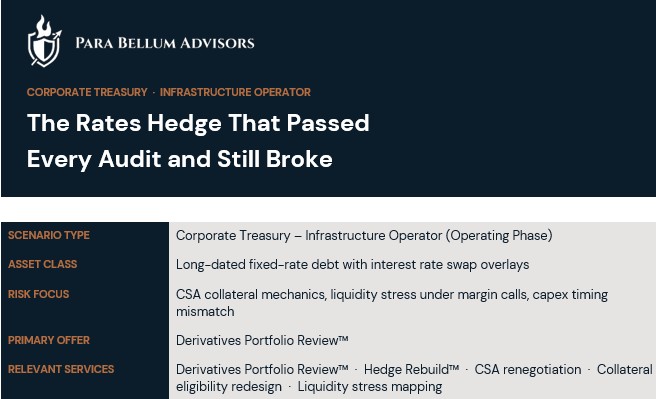
Sector: Corporate Treasury, Infrastructure Operator (Operating Phase)
Asset Class: Long-dated fixed-rate debt with interest rate swap overlays
Situation Type: Technically compliant hedge programme with unmodelled CSA collateral mechanics creating liquidity conflict with the capex programme
Primary Issue: Cash-only CSA collateral eligibility, zero-threshold margin mechanics, and absence of aggregated margin stress testing across the swap portfolio
The Situation
A large infrastructure operator with long-dated fixed-rate debt and an associated interest rate swap programme had, on paper, done everything right. Swaps were in place against every major facility. DV01 reporting was clean. The board had signed off. Hedge ratios were high.
The CSA told a different story.
The ISDA master agreement and Credit Support Annex had been signed several years earlier, largely at the bank’s drafting. Zero threshold. Daily margin calls. Cash-only collateral eligibility. Those terms were standard at the time and had never been revisited.
Nobody had stress-tested what the CSA would demand at the same moment the capex programme needed cash.
Why This Scenario Is Common
Infrastructure operators focus their derivative governance on market risk: DV01 limits, hedge ratios, counterparty credit ratings, and accounting classification. These are visible, measurable, and reportable.
CSA collateral mechanics are legal documentation, not risk metrics. They do not appear in standard treasury reports. The risk they create, a sudden and concentrated cash demand precisely when rates move, does not manifest until rates actually move. By then, the capex programme has already committed the cash.
The people who signed the CSA are frequently no longer in the treasury team. The terms are on file but have never been stress-tested against a real operating scenario.
Why It Matters
When rates moved sharply, variation margin calls clustered across multiple counterparties within a short window. The CSA thresholds provided no buffer. Cash-only eligibility meant the team could not post government securities or other liquid assets. Operating liquidity earmarked for a capital drawdown was redirected to meet derivative margin requirements.
The hedge was economically correct. The rates move was the exact scenario it had been put in place to address. The problem was not direction. It was sequencing.
After the event, the team pulled the CSA and read it, many for the first time. The terms were clear and unambiguous. None of it was hidden. It had just never been stress-tested against a real operating scenario.
How This Is Typically Addressed
Most treasury teams read the CSA after a margin event, rather than before.
Collateral eligibility and transfer thresholds are treated as operational details rather than strategic constraints. Margin stress modelling is not a standard input to treasury governance because, in benign conditions, it produces no actionable output. The next capex programme creates the same conflict.
Primary Engagement Route
Primary Offer: Derivatives Portfolio Review, covering CSA economics review, collateral eligibility mapping, and margin stress testing against the operating liquidity profile.
Secondary: CSA renegotiation support alongside client counsel, collateral eligibility redesign, counterparty concentration review, liquidity governance framework, and margin forecasting model.
Full structural narrative shared selectively on request.
Illustrative scenario for discussion purposes only. Not a transaction summary or client-specific case study.