
By Mike Duncan | May 2026
The Group Had Currency Risk Across Ten Jurisdictions. Nobody Could See It.
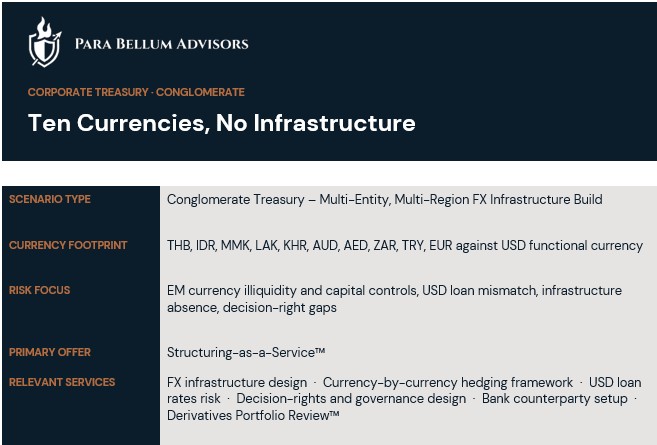
Sector: Conglomerate Treasury, Multi-Entity, Multi-Region FX Infrastructure Build
Asset Class: THB, IDR, MMK, LAK, KHR, AUD, AED, ZAR, TRY, EUR against USD functional currency
Situation Type: Multi-entity conglomerate with USD functional currency operating across ten jurisdictions, with no consolidated FX exposure view, no hedging policy, and USD-denominated capital loans inside local-currency operating entities
Primary Issue: Consolidated exposure unknown, USD loan mismatch unanalysed, hedging done reactively, entity by entity, and structurally unhedgeable currencies receiving no governance framework
The Situation
A Thailand-based conglomerate operated across ten jurisdictions with USD as its group reporting and functional currency. Revenues and costs moved through entities in Thailand, Cambodia, Lao, Myanmar, Indonesia, Australia, the Middle East, South Africa, Turkey, and a growing European presence.
Each entity managed its own local operations. None had been set up with a view to the consolidated FX position at the group level. None had a treasury management system capable of aggregating cross-entity exposures into a single view.
The group carried USD-denominated capital loans inside operating entities in Thailand, Indonesia, Australia, and Turkey, each borrowing in USD while generating revenues and costs in local currency.
FX had been managed reactively, entity by entity, using whatever the local relationship bank offered when a specific problem arose. The group had no consolidated FX policy, no hedging mandate, no counterparty framework, and no mechanism to identify the actual aggregate currency exposure.
Why This Scenario Is Common
Multi-entity family conglomerates grow by acquisition and opportunity, not by treasury design. Each entity is managed for its own operations. FX problems are solved locally when they arise.
The consolidated exposure is never visible because no single system or function is responsible for aggregating it. USD-denominated debt inside local-currency entities is treated as a financing decision, not a currency risk. The mismatch is absorbed as a finance cost when debt service falls due, without being named or governed as the FX risk it is.
The complexity of the currency footprint means that treating all currencies as a single problem produces the wrong answer for most of them. Some are fully hedgeable. Some have instrument availability with regulatory constraints. Some cannot be hedged at all through derivatives.
Why It Matters
In Turkey, the mismatch is acute. TRY has depreciated materially and persistently against USD over the past decade. An entity servicing a USD loan from TRY operating cash flows faces a debt service burden that grows in local currency terms each year without any corresponding increase in local revenue. This is not a risk of adverse currency movement. It is an ongoing compounding cost being absorbed whether recognised or not.
Without a treasury management system aggregating entity-level positions into a group view, the consolidated FX exposure is unknowable. Each entity reports locally. The group CFO receives financial statements, not exposure maps. The board cannot see what it owns.
How This Is Typically Addressed
Most conglomerates respond to currency issues on an entity-by-entity basis. A TRY depreciation event prompts a conversation with the local bank. An AUD cash flow problem is resolved through the Australian Relationship Bank. Each solution is local, reactive, and disconnected from the group position.
The consolidated view is never built because there is no trigger for building it in benign conditions. The infrastructure required to produce it, counterparty relationships, ISDA documentation, credit lines, and a governance framework, is assembled only after a problem has already become expensive.
Primary Engagement Route
Primary Offer: Derivatives Portfolio Review as an entry point, covering consolidated FX exposure mapping, USD loan structure assessment for mismatch and rates risk, and currency classification with recommended hedging approach by jurisdiction.
Secondary: Structuring-as-a-Service, covering FX infrastructure design and implementation across the full currency footprint, including hedging framework, counterparty setup, governance design, and treasury system requirements.
Tertiary: USD loan cross-currency swap and IRS structuring, EM regulatory compliance support, treasury management system selection, board-level FX reporting framework.
Full structural narrative shared selectively on request.
Illustrative scenario for discussion purposes only. Not a transaction summary or client-specific case study.