
By Mike Duncan | May 2026
The Programme Looked Cheap on Each Roll. Across 20 Rolls, It Was Not.
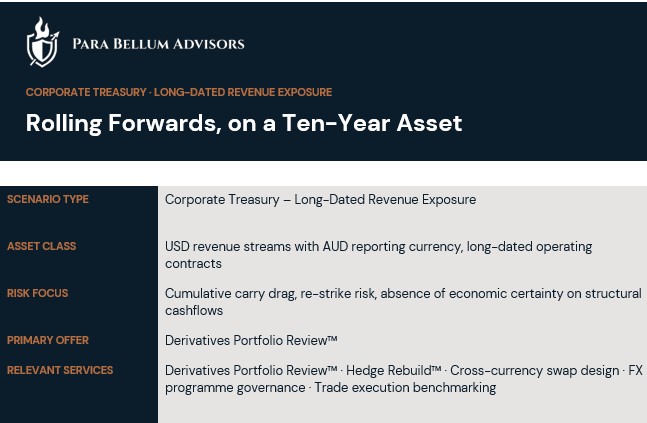
Sector: Corporate Treasury, Long-Dated Revenue Exposure
Asset Class: USD revenue streams with AUD reporting currency, long-dated operating contracts
Situation Type: Short-dated rolling FX forward programme mismatched against long-dated contractual USD revenues, with unmodelled lifecycle cost accumulation over five years
Primary Issue: Cumulative carry drag, re-strike risk at each quarterly roll, and absence of lifecycle cost comparison against a structural hedging instrument at programme inception
The Situation
A corporate with USD-denominated revenue streams from long-term operating contracts had built its FX hedging programme around rolling three-month FX forwards. The treasurer understood the instrument. The relationship bank recommended it. On a line-item basis, each roll looked cheap.
Five years into the programme, a financing review revealed a different picture.
The cumulative carry cost of rolling short-dated forwards over the period had come to approximately three times the cost of a cross-currency swap executed at programme inception. The damage was not visible in any individual transaction. It had accumulated invisibly across 20 quarterly rolls, compounding with each re-strike.
The business had been hedging a real exposure with the wrong instrument. Not because the team made a bad decision at the time, but because nobody had modelled the full lifecycle economics before committing to the approach.
Why This Scenario Is Common
Rolling FX forwards feel cheap because the cost is distributed. Each individual roll is small relative to the notional. The bank quotes a spread, treasury approves the roll, and the position is renewed. The process is familiar, and nothing looks wrong on any single transaction.
A cross-currency swap looks expensive at inception because the costs are transparent. The rolling programme looks cheap because the costs are distributed across 40 quarterly rolls over the life of a 10-year programme. The comparison is never made at inception because the lifecycle model was never run.
Why It Matters
Carry drag compounds on every roll. Where an interest rate differential exists between the two currencies, rolling forwards embed that differential as a cost on every re-strike. A cross-currency swap captures the same differential but structures it into the swap economics once, rather than paying it as a rolling cash cost on each of 40 re-strikes.
At each quarterly roll, the forward is re-struck at the prevailing market rate. If the hedged currency has moved adversely between rolls, the new forward locks in a worse rate. The hedge is present, but the economics deteriorate with each unfavourable re-strike.
A contract renewal two years into the programme had changed the volume profile, but the hedge notional had not been updated. A structural over-hedge had been running for 24 months with no documented owner for notional alignment.
How This Is Typically Addressed
Most treasury teams retain rolling forwards because they are familiar and individually uncontroversial to approve.
The lifecycle cost comparison against a structural instrument is not made at inception because it requires modelling a product that the team is not currently using. Each roll is approved on its own economics. The cumulative cost of the approach becomes visible only when someone runs the numbers retrospectively.
Primary Engagement Route
Primary Offer: Derivatives Portfolio Review, covering FX book lifecycle cost analysis, instrument suitability review, and transition pathway design.
Secondary: Cross-currency swap structuring and execution support, counterparty benchmarking framework, hedge accounting coordination, and rolling programme governance redesign.
Full structural narrative shared selectively on request.
Illustrative scenario for discussion purposes only. Not a transaction summary or client-specific case study.