
By Mike Duncan | May 2026
The Hedge Was Working. The Reporting Was the Problem. The Pressure Was to Unwind a Structure Doing Exactly What It Should.
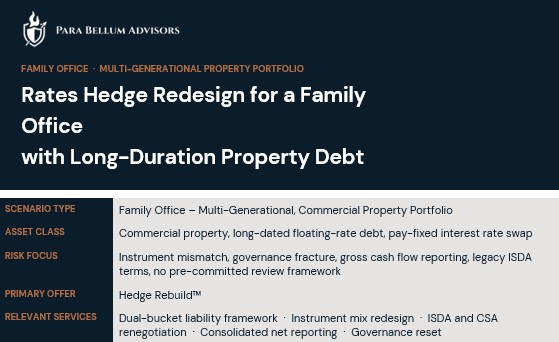
Sector: Family Office, Multi-Generational Commercial Property Portfolio
Asset Class: Commercial property, long-dated floating-rate debt, pay-fixed interest rate swap
Situation Type: Economically sound hedge programme generating Investment Committee pressure to unwind, driven by gross cash flow reporting and legacy ISDA documentation that delayed visible offset
Primary Issue: Instrument-to-liability mismatch across structural and discretionary property debt, reporting opacity from gross presentation, and legacy ISDA threshold terms making the hedge invisible in cash flow terms at exactly the moment it was most needed
The Situation
The property was performing. The debt was manageable. The hedge was the problem.
A multi-generational family office had assembled a substantial commercial property portfolio over two decades, financed through a combination of bank debt and private credit facilities, most of which were floating-rate. When rates were low, that was a deliberate choice.
To manage the interest rate risk, the family office had entered a pay-fixed interest rate swap several years earlier. When rates moved sharply, the swap moved into the money as designed. The economic benefit was real. The locked-in fixed rate was below prevailing floating rates, and the net position was sound.
What the governance process was receiving told a different story. Floating-rate debt interest payments were rising each month and were reported gross. The swap generated an offsetting economic benefit, but it was not fully visible. The ISDA documentation had been entered on legacy terms with a high bilateral threshold, meaning variation margin could not be called until the mark-to-market moved past a material level. The economic gain existed. Treasury was not yet seeing the offset in cash.
The Investment Committee was asking whether the hedge was working. The CIO was explaining, for the third consecutive quarter, why the net economic position was sound while the reported cash flows told a different story. The pressure that built was not to improve the structure. It was to unwind a hedge doing exactly what it was meant to do, at exactly the moment when unwinding it would crystallise the interest rate exposure it was managing.
Why This Scenario Is Common
Pay-fixed swap programmes for property debt are designed around the interest rate exposure, without adequate attention to how the cash flow mechanics will be presented when the hedge actually activates.
Most family office reporting systems do not automatically net swap cash flows against debt cash flows. Debt interest is reported through the property entity. The swap sits in a separate treasury or investment vehicle. The Investment Committee sees debt costs rising in one report and swap-related items in another, yet there is no single line showing the net economic position.
Legacy ISDA documentation compounds this. High bilateral threshold provisions require mark-to-market to exceed a material level before variation margin can be called. In a fast-moving rate environment, the swap moves into the money quickly, but the threshold delays incoming margin by weeks or months. The hedge is working in economic terms. It is invisible in cash flow terms.
Why It Matters
A single pay-fixed swap on aggregate debt notional treats all debt as structurally equivalent. Property portfolios carry a mix of durable exposures, assets held indefinitely, and discretionary exposures, assets that might be sold or refinanced. Hedging a discretionary exposure with a long-dated fixed-rate instrument creates an orphaned position if the asset exits.
Without a pre-committed review framework, every subsequent decision is reactive and emotionally charged. The default becomes unwinding a working structure under pressure, at the worst possible time, because the governance process has no framework to distinguish economic failure from reporting opacity.
How This Is Typically Addressed
Most family offices respond to governance pressure by modifying the hedge rather than the reporting.
The swap is reduced or unwound. The interest rate exposure that was being managed returns. When rates eventually fall or stabilise, the cost of having exited the hedge becomes visible, but by then the governance pressure has moved on. The structural problem, gross reporting and legacy ISDA terms are never addressed because the symptom was treated rather than the cause.
Primary Engagement Route
Primary Offer: Hedge Rebuild, covering interest rate programme redesign and governance reset using a dual-bucket liability framework separating structural and discretionary exposures.
Secondary: Instrument mix redesign across swap and cap structures, ISDA and CSA renegotiation, consolidated net reporting framework, Investment Committee reporting pack, pre-committed review framework.
Full structural narrative shared selectively on request.
Illustrative scenario for discussion purposes only. Not a transaction summary or client-specific case study.