
By Mike Duncan | May 2026
The Instinct Was Right. The Adviser Circle Did Not Have the Capability to Act on It.
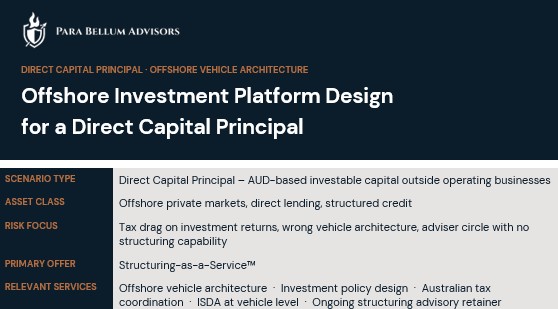
Sector: Direct Capital Principal, Offshore Vehicle Architecture
Asset Class: Offshore private markets, direct lending, structured credit
Situation Type: Accumulated investable capital held in onshore structures generating recurring tax drag, with an adviser circle unable to design and implement the offshore vehicle required
Primary Issue: Tax drag on investment returns, wrong vehicle architecture, no adviser with the structuring capability to coordinate tax counsel, legal, Singapore administrator, and investment policy into a working structure
The Situation
The principal had spent twenty years building businesses and had reached a point where the operating businesses were generating surplus capital beyond what they needed to fund their own growth. Approximately AUD 40 million had accumulated outside the operating group, sitting in a combination of direct Australian equities, a managed balanced fund, and cash.
Every dividend received was taxed at the principal’s marginal rate. Every capital gain was taxable onshore. The managed fund was distributing capital gains annually that the principal had not chosen to realise. The overall tax drag on the investment portfolio was significant and growing.
The principal had become aware that institutional investment managers he dealt with through his businesses were using offshore structures to hold their investment capital. He asked his Big Four accountant whether this was available to him. The accountant confirmed it was possible but could not say how to structure it, which jurisdictions would make sense, or how it would interact with his Australian tax position.
The instinct was correct. The adviser circle’s capacity was insufficient to act on it.
Why This Scenario Is Common
Australian high-net-worth individuals investing onshore are at a persistent structural disadvantage relative to institutional investors who operate through offshore vehicles. Every dollar of return is subject to Australian tax at the point of realisation. Compounding inside a tax-paying structure is materially less efficient than compounding inside a zero-tax structure over a long horizon.
The gap compounds in two ways: the direct tax drag on each year’s returns, and the foregone returns on tax dollars that left the portfolio each year rather than remaining invested. Over a ten to fifteen-year horizon, the difference between a properly structured offshore vehicle and a standard onshore investment account is substantial.
The adviser circle problem is structural. The accountant knows Australian tax, not offshore vehicles. The lawyer can document whatever structure is proposed, but does not have the investment management background to assess whether it fits the investment programme or creates problems six years later. The bank or fund manager has a product to distribute. Nobody coordinates the pieces.
Why It Matters
The principal also wanted access to offshore private markets and direct lending opportunities, asset classes that are difficult to access effectively through onshore structures. The natural vehicle for that kind of investing is an offshore fund structure that can hold a range of instruments and distribute returns in a tax-efficient way.
The Australian tax position does not disappear when capital moves offshore. Controlled foreign company rules, foreign investment fund rules, and the treatment of distributions from foreign entities all remain relevant. The offshore structure must be designed in conjunction with proper Australian tax advice, not instead of it. Without a structuring coordinator who understands both sides of that equation, the structure either doesn’t get built or gets built incorrectly.
The total cost of restructuring was recovered in reduced tax drag within the first eighteen months of operation.
How This Is Typically Addressed
Most principals in this position either stay onshore indefinitely or attempt to act on incomplete advice from a single adviser.
Staying onshore is the default outcome when no adviser can clearly explain the implementation pathway. The tax drag continues. The gap between the principal’s investment outcomes and those of the institutional managers he operates alongside widens each year.
Acting on incomplete advice results in structures that are either too conservative to achieve the tax-efficiency objective or too aggressive to withstand ATO scrutiny. Either way, the coordination failure between tax, legal, and investment management means the structure does not perform as intended.
Primary Engagement Route
Primary Offer: Structuring-as-a-Service, covering offshore investment vehicle architecture and investment policy design. Singapore Variable Capital Company structure selected as the primary vehicle, with a sub-fund structure for asset-class ring-fencing and ISDA documentation at the vehicle level for direct lending instruments.
Secondary: Ongoing structuring advisory retainer for transaction-level structuring support as the investment programme develops. Coordination with tax counsel and Singapore administrator.
Full structural narrative shared selectively on request.
Illustrative scenario for discussion purposes only. Not a transaction summary or client-specific case study.