
By Mike Duncan | May 2026
The FX Policy Was Governing a Business That No Longer Existed
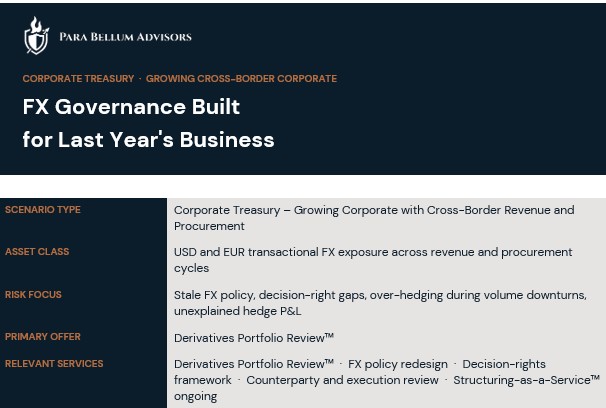
Sector: Corporate Treasury, Growing Cross-Border Corporate
Asset Class: USD and EUR transactional FX exposure across revenue and procurement cycles
Situation Type: Stale FX policy governing a business that had materially changed in revenue mix, procurement profile, and commercial cycle length
Primary Issue: Hedge ratio policy without decision rights, forecast exposures not dynamically updated, and hedge P&L disconnected from operating performance
The Situation
A corporate with growing cross-border revenue and USD and EUR procurement had written its FX treasury policy three years earlier, when the business was predominantly domestic.
The policy was clear. The board had approved it. The banks had been briefed.
Since then, the business had changed substantially. International revenues had grown from a minor line item to a material share of total income. Procurement relationships had diversified. One significant contract had shifted billing currency mid-term.
The FX policy had not changed. The hedge programme was doing exactly what the policy instructed. The policy was no longer describing the business it was meant to govern.
Why This Scenario Is Common
FX policies are written once and reviewed rarely.
When businesses grow into cross-border operations, the commercial cycle, exposure timing, and revenue mix all shift. The policy does not move with them. Decision rights are never specified in the original document, because at inception, the exposure was simple enough that nobody thought to ask who owned the trigger.
When volume moves or a contract is renegotiated, there is no process for passing that information to treasury. The hedge runs against an exposure that no longer exists.
Why It Matters
This is not a market risk failure. The FX rates moved as they always do.
When international revenue contracted following a client renegotiation, the hedge notional, set against the prior year’s forecast, significantly exceeded actual exposure. Forward contracts generated mark-to-market losses. Directors were asked to explain losses on positions that had no corresponding cash flow.
One contract had its billing shifted from USD to AUD mid-term. The USD hedge remained in place for months, creating a naked FX position that the treasury had never intended to take.
The policy defined what proportion to hedge. Nobody owned the moment at which the economic exposure was actually taken on by the commercial team.
How This Is Typically Addressed
Most treasury teams respond to stale policy with documentation updates.
The ratio gets adjusted. The coverage percentage is revised. The written policy improves. The decision-right gap persists because no one has mapped the commercial lifecycle and assigned ownership at each stage.
The hedge programme continues to run on stale or incomplete information. The next volume contraction produces the same result.
Primary Engagement Route
Primary Offer: Hedge Rebuild™: Derivatives Portfolio Review, covering FX policy gap analysis, commercial lifecycle mapping, and decision-rights framework design.
Secondary: FX policy redrafting, commercial team integration design, hedge accounting qualification review, execution benchmarking, and Structuring-as-a-Service ongoing oversight.
Full structural narrative shared selectively on request.
Illustrative scenario for discussion purposes only. Not a transaction summary or client-specific case study.