
By Mike Duncan | May 2026
Timing Instinct Is Not a Hedging Policy. The Unhedged Position Was the Risk.
Sector: Direct Capital Principal, Multi-Currency Operating Group
Asset Class: Multi-currency operational FX exposures, USD and local currency revenues across Australia, Vietnam, and Indonesia
Situation Type: Unmanaged operational FX exposure across a multi-entity group, with timing-based repatriation decisions substituting for a governed hedging programme
Primary Issue: No exposure map, no ISDA documentation, no policy, and an adviser circle that had discouraged hedging without being able to say what should be done instead
The Situation
A Brisbane-based principal had spent a decade building a group of businesses with operations in Australia, Vietnam, and Indonesia. The Australian entity generated revenue in AUD. The offshore businesses generated revenue in USD and local currencies. Intercompany funding flowed both ways, depending on where capital was needed.
On paper, the group was profitable and growing. In practice, a meaningful portion of that profitability was being eroded by currency movements that nobody was formally managing.
The approach was timing. When the AUD was weak, the principal delayed repatriating USD earnings. When the AUD was strong, he moved money quickly. This was instinct, not policy. It had worked some of the time. In two specific years it had produced repatriation decisions that were materially worse than a simple forward hedge would have delivered.
The principal’s accountant had advised that hedging was complex and risky. That advice was not wrong in the abstract. It was wrong for this situation, because the actual risk was the unhedged position, not the hedge.
Why This Scenario Is Common
Multi-currency operational businesses accumulate FX exposure in ways that are easy to ignore when the currency environment is benign. The exposure does not appear on the balance sheet in a way that creates governance pressure. There is no mark-to-market. There is no margin call. There is just a lower profit figure at year’s end, attributed to conditions rather than a lack of management.
The intercompany structure adds complexity. Loan accounts between entities are used to manage cash flow across the group, denominated in whichever currency was convenient at the time. The resulting exposure is partially self-offsetting, making it difficult to map without dedicated analysis.
Adviser circles around direct capital principals typically include a commercial accountant and a commercial lawyer. Neither has derivatives documentation or hedging experience. Bank FX conversations fill the gap but they are product conversations, not exposure conversations.
Why It Matters
By the time the engagement began, the principal had a reasonable sense that he had a currency problem. He did not know its size, direction, or where it sat within the group structure.
The intercompany loan accounts had been built up across years of ad hoc transfers. Some were denominated in AUD, some in USD, some in whatever currency was convenient. The resulting exposure was complex and partially self-offsetting, invisible without a dedicated exposure map.
Both relationship banks had pitched FX products. Both conversations had left the principal with the impression he was being sold something. That scepticism was well-founded. He had no independent basis on which to evaluate what was being proposed.
How This Is Typically Addressed
Most principals in this position either do nothing or follow a bank recommendation without independent assessment.
Doing nothing is the most common outcome, particularly where an accountant has framed hedging as complex and risky. The timing instinct continues. The exposure accumulates. The year-end profit figure reflects currency conditions rather than currency management.
Following a bank recommendation without an independent assessment typically produces a hedge that addresses the visible problem without mapping the full exposure. Natural offsets within the group structure go unidentified. The hedge may double up on an existing offset or leave the real exposure unaddressed.
Primary Engagement Route
Primary Offer: Derivatives Portfolio Review, covering FX exposure mapping and hedging architecture across all three jurisdictions, including intercompany loan positions and natural offsets within the group structure.
Secondary: Hedging policy documentation, ISDA and CSA negotiation support alongside legal counsel, instrument selection and execution guidance, ongoing monitoring framework.
Full structural narrative shared selectively on request.
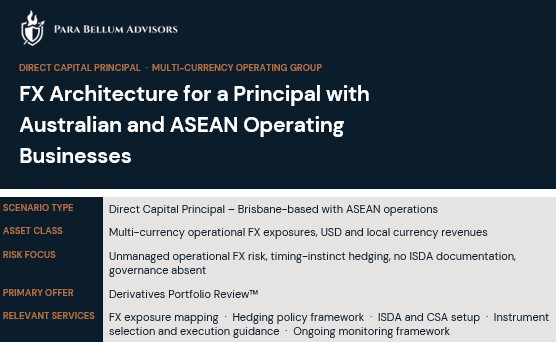
Illustrative scenario for discussion purposes only. Not a transaction summary or client-specific case study.