
By Mike Duncan | November 2026
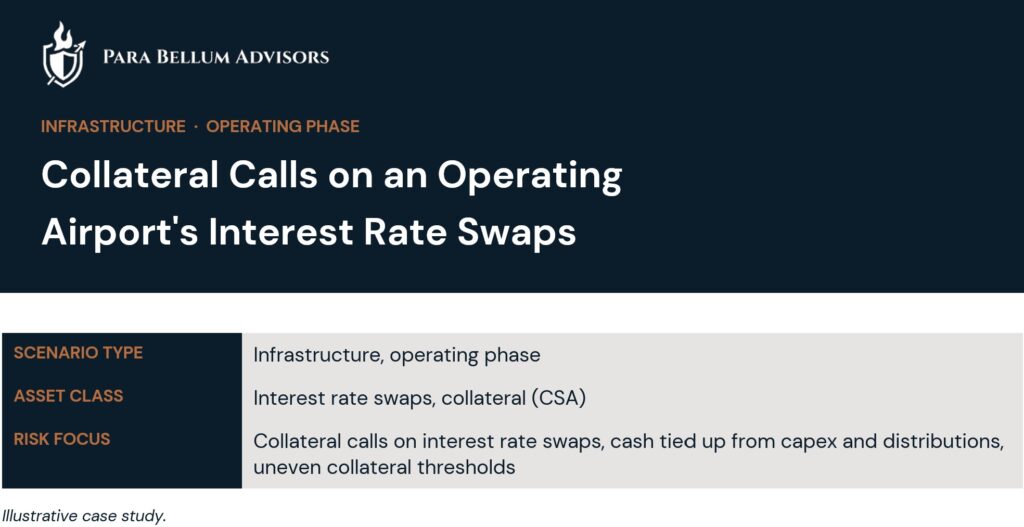
A hedge that worked still tied up AUD30m of cash
The Situation
An infrastructure fund bought a regional airport and financed it with about AUD500m of floating-rate senior debt. At acquisition the fund fixed the interest cost for nine years with interest rate swaps from two banks. That was near the top of the rate cycle, which is when fixing looks prudent, and the business itself did what the fund expected: within two years passenger numbers were at a record and earnings were ahead of plan.
The swaps sat under collateral agreements (CSAs) with cash posted daily, a zero threshold for the airport and AUD20m for each bank. The CSAs had been accepted because they brought the fixed rate down by about 0.15% (15 basis points) a year: with collateral in place, the banks no longer needed to charge much for the credit, funding and capital cost of a long-dated swap to a single-asset borrower. The numbers put to the investment committee showed a saving of about AUD0.75m a year, with the largest likely collateral call at about AUD10m.
Two years on, about AUD30m of the airport’s cash was sitting with the two swap banks. The board had approved AUD60m of terminal and car park works, projects expected to return well above the cost of debt, and the airport could no longer fund them from cash flow.
Why a Working Hedge Needed Cash
When the airport pays fixed and receives floating, the swap loses value as rates fall. Over the life of the swap that loss is matched by lower floating-rate interest on the debt, so as a hedge it does what it was designed to do. Under the CSA, though, the loss must be backed with cash (variation margin) as it happens, while the offsetting saving on the debt arrives a quarter at a time over the next seven years.
With about seven years left to run, a swap on AUD500m moves by about AUD0.3m for every 0.01% (one basis point) move. The fixed rate was now about 1% above the seven-year market rate, which put the swaps at about AUD30m against the airport, and with a zero threshold on its side all of it was called. The investment case had tested collateral for a 0.25% move, with nothing for 1% or 2% in either direction. Had rates gone the other way, the banks would have posted nothing until the swaps were more than AUD20m in the airport’s favour with each bank.
The terms made most of the difference. With a two-way threshold of AUD10m per bank, the airport would have posted only the amount above AUD10m with each bank. With the exposure split evenly, AUD15m per bank, that is about AUD5m to each, AUD10m in total rather than AUD30m.
The Lesson
Test It on Your Own Numbers
– Revalue your swaps for a 1% fall in rates. How much collateral would you post, and from what source?
– Read your CSA thresholds in both directions. What is yours, and what is the banks’, and what would a two-way threshold have changed?
– Ask your banks what it would cost to move the swaps into the secured lending group with no CSA and compare it with what the CSA saved you when the swaps were put on and with the cost of a liquidity facility.
If you pay fixed under a CSA, a fall in rates can take cash you had set aside for capex or distributions. If you don’t know how much a 1% fall in rates (100 basis points) would take from yours, that’s worth an exploratory discussion.
What the calls cost the airport, the options the board weighed and what it chose are in the full case study.
For wholesale clients only. Not investment advice.
This illustrative case study is provided for information purposes. It does not constitute investment advice, financial product advice or a recommendation to transact. Views reflect Para Bellum Advisors’ judgement at the time of writing and may change without notice. Readers should obtain their own independent advice before making any investment or risk-management decision. © Para Bellum Advisors, 2026. All rights reserved.