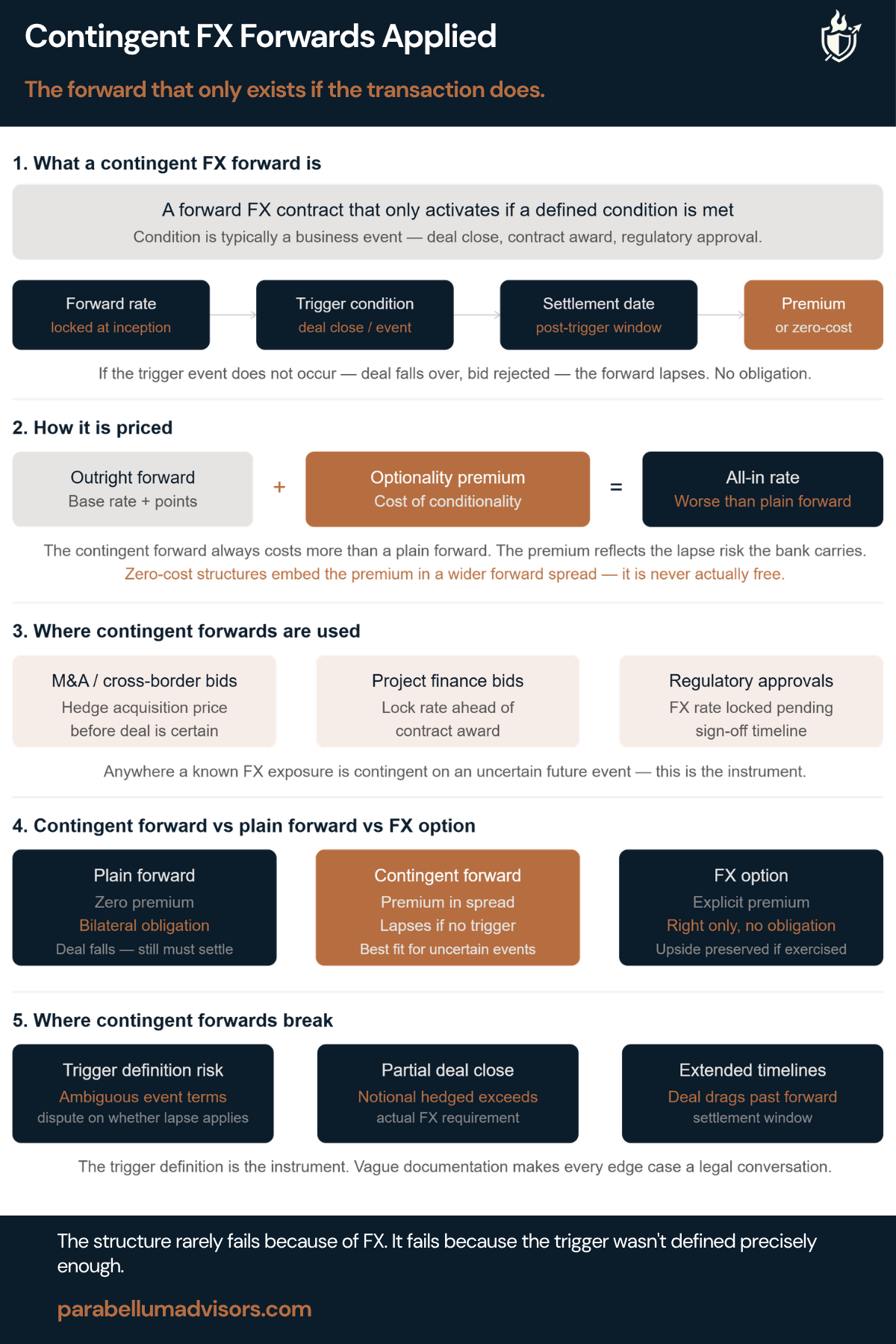
Contingent FX forwards. The forward that only fires if the deal closes.
A standard FX forward removes exchange rate uncertainty. It also creates certainty where you may not want it. Once executed, both parties are committed to settle regardless of what happens to the underlying transaction.
That is fine if the exposure already exists. It is much less useful when the exposure is still uncertain.
Cross-border acquisitions, project bids and regulatory approvals all have one thing in common. The currency risk is real, but only if the transaction actually happens. A contingent forward is designed for exactly that situation.
Five things corporate treasuries and deal teams should understand.
1. What a contingent forward actually is
A contingent forward looks much like a standard forward. The exchange rate is agreed at inception, but settlement only becomes mandatory if a defined business event occurs within an agreed period. If the acquisition completes, the contract settles. If it does not, the forward simply lapses. The hedge only exists if the underlying exposure does.
2. Nothing is free
The flexibility has a cost. The bank accepts the risk that your transaction never completes after it has begun managing its own exposure. Sometimes that cost is explicit. More often it is reflected in a less favourable forward rate. Either way, the optionality is being paid for.
3. Where it works best
The most common application is cross-border M&A, where bidders want certainty over the acquisition price without creating an FX obligation if the deal falls over. The same principle applies to project bids, competitive tenders and transactions awaiting regulatory approval. Whenever the commercial event is uncertain, an unconditional hedge can create more risk than it removes.
4. Why not just use an option?
An FX option also removes the obligation to transact and preserves favourable currency moves, but it requires an upfront premium. A contingent forward sits between a plain forward and an option. It is generally cheaper than buying optionality outright, but once the trigger is met the exchange rate is fixed.
5. Where programmes fail
Most problems have little to do with foreign exchange. They come from the documentation. If the trigger is not defined precisely, disagreements quickly emerge over what constitutes completion, partial completion or regulatory approval. The hedge usually behaves exactly as expected. The uncertainty is whether everyone agrees the trigger has occurred.
A contingent forward is the right instrument when the FX exposure depends on a future business event rather than an existing obligation. The structure is straightforward. The difficult part is making sure the documentation is just as precise as the pricing.
For corporate treasuries and deal advisers, the key question is not whether the exchange rate is protected. It is whether the trigger has been defined clearly enough that the hedge behaves exactly as intended if the transaction changes, is delayed or never completes.