
By Mike Duncan | May 2026
The Positions Were on the Books. Nobody Could Fully Explain Why.
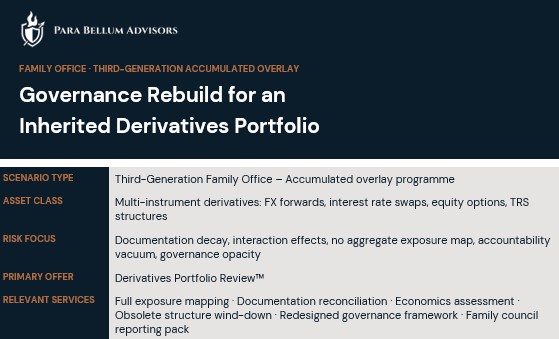
Sector: Family Office, Third-Generation Accumulated Overlay
Asset Class: Multi-instrument derivatives, FX forwards, interest rate swaps, equity options, total return swap structures
Situation Type: Third-generation family office with an inherited overlay programme built by a departed CIO, where no aggregate exposure map existed, interaction effects were unknown, and governance reporting presented positions individually rather than as a portfolio
Primary Issue: Documentation decay, interaction effects between structures creating unintended exposures, accountability vacuum, and a family council receiving summary reports that could not be explained or defended
The Situation
The positions were on the books. Nobody could fully explain why.
A third-generation family office had inherited an overlay programme built over fifteen years by a CIO who had left two years earlier. The programme had been thoughtfully constructed, with each structure added for a reason that made sense in its own context. FX forwards on offshore equity. An interest rate swap on property debt. Several equity option structures on concentrated stock positions. A total return swap on a private credit fund entered as a yield enhancement. A currency overlay redesigned three times across different market regimes.
By the time the third generation took operational responsibility, the programme was a collection of positions that had outlived the decisions that created them. The original CIO’s mental model of how the structures interacted was not documented anywhere. Roll decisions had been made on a judgmental basis, without a written policy.
The new generation understood that the positions existed. What they could not do was articulate, to themselves or to the family council, what the programme was doing in aggregate, what the liquidity exposure was across the book, or which structures were still earning their carry and which were historical artefacts rolling quietly with no active decision to keep them.
Why This Scenario Is Common
Derivatives portfolios in family offices accumulate the same way as the rest of the portfolio: through individual decisions each sensible at the time, without anyone maintaining a system-level view of what the whole thing is doing.
Derivatives, unlike most other assets, do not sit passively. They roll. They generate margin. They interact with each other in ways not visible in standard portfolio reporting. A long equity option and a short currency forward can offset each other, making both appear to work without either being necessary. A total return swap on a private credit fund and an interest rate swap on the same fund’s debt create an embedded leverage position that may not appear anywhere on the risk report.
When the decision-maker who understood those interactions leaves, the understanding leaves with them.
Why It Matters
The aggregate picture in this case revealed interactions not visible in existing reporting. The total return swap on the private credit fund and an interest rate swap on the same manager’s debt had created a combined duration position that was significantly larger than either position would have suggested individually. A currency forward entered to hedge an offshore equity allocation was partially offset by a natural currency gain elsewhere in the portfolio, reducing the effective hedge ratio below what governance understood it to be.
A trustee signing annual accounts had no independent basis for confirming that the derivatives programme had been reviewed and was being governed. The family council was receiving summary reports that could not be explained if challenged. The governance process was experiencing the portfolio through its failure modes rather than through a forward-looking framework.
Documentation decay compounded the exposure problem. ISDA terms negotiated for a specific economic logic in a prior market regime had become permanent contracts. CSA threshold provisions, which were appropriate when asset values differed, were no longer calibrated to the actual portfolio.
How This Is Typically Addressed
Most inherited derivatives portfolios are maintained rather than reviewed. The new generation of decision-makers inherits the positions alongside the rest of the portfolio and manages them individually as they mature or roll.
The interaction effects between structures are never mapped because doing so requires assembling data from multiple counterparties and systems into a single view. The obsolete structures continue rolling. The documentation terms persist. The governance opacity continues until a specific position generates a problem that forces a review.
Primary Engagement Route
Primary Offer: Derivatives Portfolio Review, covering full exposure mapping, documentation reconciliation, economics assessment, and obsolete structure identification.
Secondary: Sequenced wind-down of obsolete structures, CSA and counterparty documentation review, redesigned governance framework, and family council reporting pack.
Full structural narrative shared selectively on request.
Illustrative scenario for discussion purposes only. Not a transaction summary or client-specific case study.