
By Mike Duncan | May 2026
The 2022 Drawdown Did Not Break the Portfolio. It Revealed It.
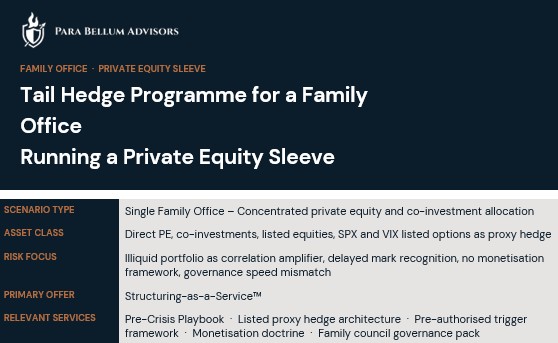
Sector: Family Office, Private Equity Sleeve
Asset Class: Direct private equity, co-investments, listed equities, SPX and VIX listed options as proxy hedge
Situation Type: Single family office with a forty per cent illiquid allocation that deferred and concentrated losses during a stress period rather than diversifying them, with no protection programme and no governance framework capable of operating at the speed of a tail event
Primary Issue: Delayed mark recognition in private markets misread as genuine resilience, no monetisation doctrine, governance speed incompatible with the window during which a tail hedge is valuable
The Situation
The 2022 drawdown did not break the portfolio. It revealed it.
A single-family office had aggressively allocated to direct private equity and co-investments over the prior three years. The thesis was sound: the family had operational expertise in the sectors they were backing, deal flow through relationships, and a long enough time horizon to accept illiquidity. The allocation had reached approximately 40% of the total portfolio value by the time market conditions changed.
When listed markets sold off, the family office’s overall portfolio performance looked surprisingly resilient for several months. Listed equities fell. Private equity marks moved only modestly. The Investment Committee noted the diversification benefit and moved on.
What followed over the next twelve months was a second wave. Private equity marks, reported at cost or modest discount, were revalued as underlying businesses refinanced at higher rates and faced margin compression. The losses that had appeared well-contained arrived all at once.
The private allocation did not diversify the portfolio during the stress period. It had deferred and concentrated the losses. The family office had no protection in place, no rebalancing capacity, and no pre-committed framework for what to do when a stress event arrived.
Why This Scenario Is Common
Private equity performs the way it does through a stress period, not because the underlying businesses are unaffected, but because the reporting cycle creates a lag. Quarterly valuations, GP discretion in applying comparable multiples, and the absence of a secondary market that clears at transparent prices all contribute to a picture that looks better than it is while conditions are deteriorating.
The problem arises when the family office interprets smoothed reporting as evidence of genuine resilience rather than a timing artefact. The natural response to listed market stress, adding protection or reducing risk, is suppressed by the misleading signal from the private allocation.
A portfolio with 40% in illiquid private equity also has limited ability to rebalance. When listed equities fall sharply, the private allocation’s share of the total portfolio rises mechanically. The office becomes more concentrated in the illiquid component at exactly the moment when its actual value is declining but not yet visible.
Why It Matters
A hedge that pays in a stress event but has no pre-committed framework for when and how to realise gains is only partially useful. If gains accumulate but the governance process requires a committee meeting to authorise any action, the window during which gains are realisable at peak may close before authority is granted.
A VIX spike from 15 to 45 happens in days. The window during which a tail hedge is maximally valuable is short. A governance process operating on weekly or monthly cycles is not compatible with the speed at which that window opens and closes.
OTC instruments, often pitched as more cost-effective than listed options, introduce an additional problem under stress conditions. For a family office without a trading desk, OTC liquidity in a stress event is not reliable. Listed instruments can be monetised at any point during trading hours without counterparty negotiation.
How This Is Typically Addressed
Most family offices with significant private allocations do not run a formal tail hedge programme. The illiquid allocation is treated as inherently stable, and the protection question is not asked until a stress event has already begun.
When protection is considered, it is typically framed as a cost question rather than a design question. The cheapest instrument is selected. No monetisation doctrine is established. No governance pre-authorisation is put in place. The instrument pays out during a stress event, and the gains remain unrealised while the governance process decides what to do with them.
Primary Engagement Route
Primary Offer: Structuring-as-a-Service, Pre-Crisis Playbook, covering tail hedge architecture design, instrument selection, monetisation doctrine, and governance framework.
Secondary: Listed proxy hedge implementation pathway, pre-authorised trigger framework, partial monetisation band design, family council governance and reporting pack.
Full structural narrative shared selectively on request.
Illustrative scenario for discussion purposes only. Not a transaction summary or client-specific case study.