
By Mike Duncan | May 2026
The Wealth Was Real. The Lending Market Could Not Work With It.
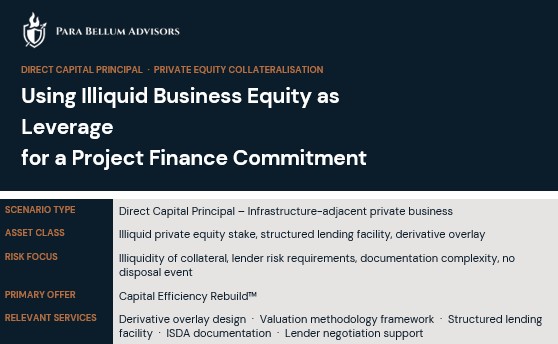
Sector: Direct Capital Principal, Infrastructure-Adjacent Private Business
Asset Class: Illiquid private equity stake, structured lending facility, derivative overlay
Situation Type: Principal with material illiquid business equity seeking to fund a project finance commitment without a disposal event, personal guarantees extending beyond the collateral, or operating covenants on the business
Primary Issue: Conventional lending channels are either unavailable or require protections that were unacceptable, with no adviser capable of designing the derivative overlay that would give a lender sufficient comfort to proceed on workable terms
The Situation
The principal owned a significant stake in a privately held business operating in the waste management and resource recovery sector. The business was profitable, had predictable cash flows, and had attracted interest from infrastructure funds as a potential acquisition target. It was not for sale.
An opportunity had emerged to commit equity capital to a greenfield project finance deal in the same sector, a long-dated infrastructure asset with a clear offtake structure and government involvement. The economics were compelling. The problem was capital.
The principal had cash, but not enough to fund the commitment at the scale that would give him a meaningful position. His existing business equity represented substantial wealth that was generating a strong return but was entirely illiquid.
His commercial bank had offered a facility, but only against the operating business’s cash flow. The covenants they required would have constrained the operating business in ways the principal was not prepared to accept. The co-investors were institutional, with a closing timeline. If committed capital could not be demonstrated within that window, the allocation would be reallocated.
Why This Scenario Is Common
Private business owners at this scale regularly encounter the same structural problem. Their wealth is real and growing, but it is concentrated in an illiquid form that the conventional lending market finds difficult to work with.
Banks that lend against private company equity typically require one of three things: a clear exit path within the loan term, personal guarantees extending well beyond the collateral, or covenants on the operating business that effectively give the bank a degree of control the owner never intended to grant.
The co-investor closing timeline made the problem acute. There was no time to find a conventional solution that did not exist. What was needed was a structuring answer to a valuation problem, and the adviser circle, a commercial lawyer, an accountant, and a relationship bank credit team, had nobody who could design one.
Why It Matters
The lender’s core problem with illiquid equity collateral is valuation uncertainty. Without mark-to-market valuation, lenders cannot run standard margin maintenance tests. Without that, they require personal guarantees, cross-collateralisation, or operating covenants, each of which introduces risks the borrower had not intended to take, and the operating business had been deliberately ring-fenced against.
Operating covenants requiring lender approval for capex, dividends, or new facilities are not standard credit protections. They have a degree of influence over the business that no owner voluntarily accepts. They were presented as standard. They were not.
The derivative overlay changed the lending conversation. A properly structured put option on the equity value gives the lender a credible floor below which the collateral cannot fall. That converts a security of dubious value into a facility with bounded downside. The derivative does not eliminate the equity’s illiquidity. It eliminates the valuation uncertainty that makes the lender unwilling to lend against it.
How This Is Typically Addressed
Most principals in this position accept whatever the relationship bank offers, decline the investment opportunity, or attempt to raise capital through other means at high cost.
Accepting the relationship bank’s terms means accepting the operating covenants. For a principal who has spent years ring-fencing the business from external influence, this is often a dealbreaker in practice, even when it appears acceptable in principle.
Declining the investment opportunity is the most common outcome when the structuring answer is not available within the timeline. The capital sits in the operating business. The project finance opportunity is reallocated.
Primary Engagement Route
Primary Offer: Capital Efficiency Rebuild, covering private equity collateralisation and lending facility design, including derivative overlay design using a contractually defined valuation methodology agreed with both the option counterparty and the lender.
Secondary: Structuring-as-a-Service for the derivative overlay design, valuation methodology framework, ISDA documentation, lender negotiation support alongside legal counsel.
Full structural narrative shared selectively on request.
Illustrative scenario for discussion purposes only. Not a transaction summary or client-specific case study.