
By Mike Duncan | May 2026
70% of Net Worth in One Listed Name. The Adviser Circle Had No Answer.
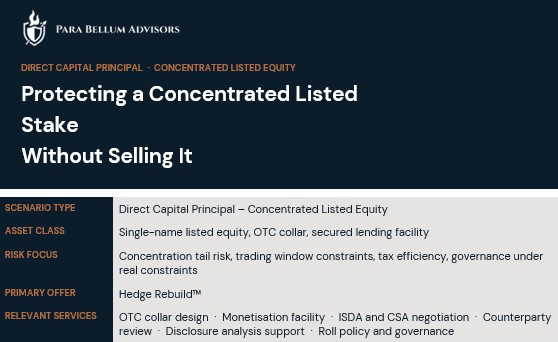
Sector: Direct Capital Principal, Concentrated Listed Equity
Asset Class: Single-name listed equity, OTC collar, secured lending facility
Situation Type: Founder-held concentrated listed position with narrow trading windows, disclosure constraints, and an adviser circle with no structuring capability to design a solution around those constraints
Primary Issue: Concentration tail risk unaddressed, each delay narrows the available window and makes the next conversation harder, while adviser conversations stayed at the level of estate planning and tax deferral
The Situation
The founder had built a logistics business over fifteen years and taken it public. The IPO was successful. The stake that remained, still around sixty per cent of net worth, was a direct consequence of how the float was structured: enough sold to create liquidity for the business, not enough to meaningfully de-risk the founder’s personal balance sheet.
His advisers were a commercial law firm that handled the IPO documentation and a Big Four accountant that managed the group tax structure. Neither knew how to think about what came next. The conversations stayed at the level of estate planning and tax deferral. Nobody was asking the question underneath those conversations.
What happens to this family’s financial position if the stock falls by forty per cent in a quarter where the trading window is shut?
The stock was well run. The business was real. None of that was the issue. The issue was that 70% of net worth was in a single listed name with quarterly windows, a board that watched every on-market move, and a founder who had spent 15 years building something he was not psychologically ready to sell.
Why This Scenario Is Common
Founder-held listed positions drift toward inaction through a sequence that looks rational at each step.
Early on, the stock performs. Urgency disappears. Then a quiet quarter arrives, and someone mentions hedging. The bank pitches a collar. The accountant flags potential tax complications. The lawyer flags disclosure obligations. Nobody can independently evaluate the economics. The conversation stalls. Doing nothing becomes the default.
The risk is not that a disaster happens suddenly. It is that each delay makes the next conversation harder, the window narrower, and the available structures less attractive than they would have been twelve months earlier.
Why It Matters
Listed put options solve the instrument problem while creating a disclosure problem. They are visible on the market, sending exactly the wrong signal. Liquidity at useful strikes and tenors is thin.
A zero-cost collar, as typically pitched by a relationship bank, is not free. The cost is foregone upside above the call strike, which is psychologically and economically real in a concentrated founder position where upside participation is non-negotiable below a certain level.
OTC structures solve the signalling and sizing problems but introduce CSA mechanics, initial margin requirements, and variation margin behaviour that most founders and their advisers have never managed. Without structuring support, the solution becomes a second problem.
The adviser circle, a commercial lawyer, a Big Four accountant, and a relationship bank, had no one who could design around all of those constraints simultaneously.
How This Is Typically Addressed
Most founders in this position either do nothing indefinitely or accept a bank-pitched structure without independent economic evaluation.
Doing nothing is the most common outcome. The trading window constraints and disclosure concerns create genuine friction that, without a structuring adviser, results in paralysis rather than action. Each year, the position grows as a percentage of net worth. Each year, the conversation becomes harder.
Accepting a bank-pitched collar without independent assessment means the strike levels, tenor, and cost structure are set by the counterparty rather than an analysis of what the founder actually needs.
Primary Engagement Route
Primary Offer: Hedge Rebuild, covering concentrated equity protection, structure design, OTC implementation pathway, governance and roll policy.
Secondary: Monetisation facility design, ISDA and CSA negotiation alongside legal counsel, counterparty review, disclosure analysis support, and family governance narrative.
Full structural narrative shared selectively on request.
Illustrative scenario for discussion purposes only. Not a transaction summary or client-specific case study.