
By Mike Duncan | May 2026
The Relationship Was Comfortable. That Was the Structural Problem.
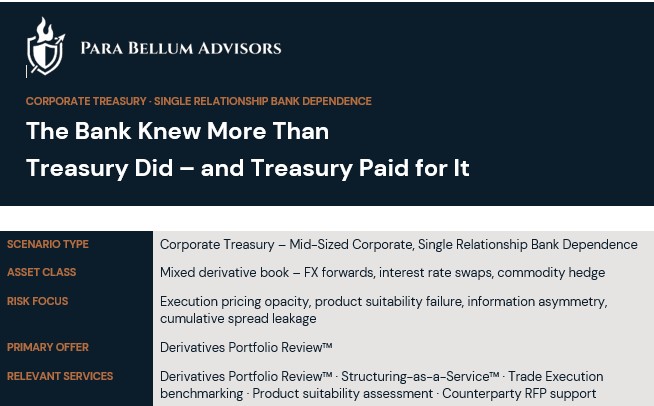
Sector: Corporate Treasury, Mid-Sized Corporate, Single Relationship Bank Dependence
Asset Class: Mixed derivative book, FX forwards, interest rate swaps, commodity hedge
Situation Type: Three-year derivative programme executed exclusively with relationship banks, with no independent benchmarking, no product suitability review, and documentation terms consistently drafted in the bank’s favour
Primary Issue: Execution pricing opacity, product suitability failure, information asymmetry, and cumulative spread leakage across three years of quarterly rolls
The Situation
A mid-sized corporate with a two-person treasury team had managed its derivative book for three years through two relationship banks. FX forwards against offshore revenues. Two interest rate swaps from debt facilities. A commodity hedge put in place when input costs spiked.
Every transaction had been executed with one of the two banks that provided the company’s debt facilities. No competitive quote had been sought on any transaction. No independent view on product suitability had been obtained.
The team was capable and diligent. The banks were professional and responsive. The relationship was comfortable and long-standing.
That was the problem.
Why This Scenario Is Common
The bank’s relationship with a corporate treasury is not adversarial. It is professional, often genuinely helpful, and built over years of facility management and goodwill.
But the relationship is not symmetric. The bank has a derivatives desk measured by revenue. It prices against its own book. It recommends products it can execute and distribute. When a corporate treasury team calls to roll an FX forward, the price quoted is the price the bank has decided to give. There is no consolidated order book, no reference price, and no way for the treasury to know how far that price is from mid.
Over time, this asymmetry compounds. Each transaction is individually small enough to approve without scrutiny. Cumulatively, across three years of quarterly rolls, swap amendments, and new hedges, the leakage is material.
Why It Matters
One interest rate swap was amended at the bank’s suggestion to extend its tenor by 3 years, framed as a way to reduce refinancing risk. The extension embedded the option value in the bank’s favour. Not disclosed as a material term. It was in the documentation.
The commodity hedge was executed as a vanilla fixed-price swap, the bank’s recommended instrument. A collar would have provided equivalent protection at a fraction of the cost. The commodity cycle subsequently moved materially in the corporate’s favour. The swap eliminated every dollar of that benefit.
A retrospective benchmarking exercise showed consistent spread leakage on the majority of FX forward rolls. No single roll was egregious. Across the programme size and duration, the cumulative leakage was significant.
How This Is Typically Addressed
Most treasury teams accept that execution pricing with relationship banks is an unavoidable cost of the facility relationship.
Product recommendations are evaluated by the team’s own assessment of the instrument. Where bandwidth is limited, the bank’s recommendation is accepted. There is no mechanism for generating alternatives because generating alternatives requires time the team does not have. The asymmetry is structural and self-perpetuating.
Primary Engagement Route
Primary Offer: Derivatives Portfolio Review, covering execution benchmarking, product suitability assessment, and documentation review across the existing book.
Secondary: Commodity hedge restructuring, swap amendment remediation, counterparty RFP support, and Structuring-as-a-Service retained function for ongoing independent coverage.
Full structural narrative shared selectively on request.
Illustrative scenario for discussion purposes only. Not a transaction summary or client-specific case study.