
By Mike Duncan | May 2026
When Nobody Reviews the Portfolio, the Bank Fills the Gap
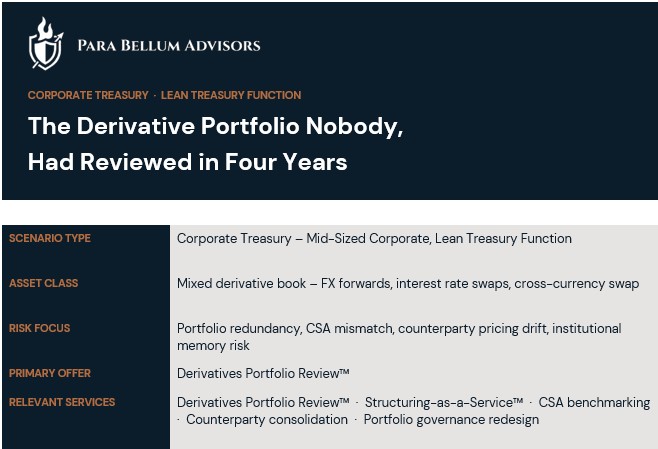
Sector: Corporate Treasury, Mid-Sized Corporate, Lean Treasury Function
Asset Class: Mixed derivative book, FX forwards, interest rate swaps, cross-currency swaps
Situation Type: Incrementally built derivative book with no portfolio-level review, CSA terms from a prior credit era, and institutional memory lost on the departure of the executing treasurer
Primary Issue: Portfolio redundancy, CSA mismatch, counterparty pricing drift, and absence of documented hedge rationale
The Situation
A mid-sized corporate with a two-person treasury team managed a derivatives book that had grown piecemeal over several years. FX forwards against offshore revenues. Two interest rate swaps from debt facilities. A cross-currency swap inherited from a refinancing that nobody on the current team had been present for.
The team was diligent. Settlements were processed, confirmations maintained, and the CFO received a quarterly report. Nothing was obviously broken.
Nothing had been reviewed as a portfolio. Each trade existed because it had made sense at the time it was executed. Whether it still made sense, whether it matched a current exposure, whether the CSA reflected current credit standing, whether pricing remained competitive, had never been examined.
When the treasurer who had executed the original trades left, what remained was a set of live positions with no documented rationale and no independent benchmark.
Why This Scenario Is Common
Lean treasury teams face a structural constraint that counterparty banks do not: time.
A two-person team managing operational responsibilities alongside a growing derivative book has no bandwidth to run counterparty RFPs, benchmark execution pricing, or challenge product suitability on live transactions.
The relationship bank prices each transaction against its own book, recommends products it can execute, and amends documentation to protect its own position. Over time, the gap between what treasury believes it is paying and what it is actually paying widens invisibly. There is no event, no failure, no obvious signal.
Why It Matters
One interest rate swap had been put in place against a debt facility that had since been partially repaid. The swap notional no longer matched the outstanding debt. The hedge was oversized relative to the actual exposure, creating a speculative position that the treasury had not consciously decided to hold.
The cross-currency swap CSA embedded terms consistent with the company’s credit profile from three years prior. A renegotiated CSA reflecting current standing would have materially reduced the frequency and amount of collateral posting.
No position had a documented rationale. An auditor’s query would have been very difficult to answer.
How This Is Typically Addressed
Most teams run the positions until maturity and add governance around new transactions.
The existing book is not reviewed against current exposures. CSA terms are not benchmarked. The institutional memory problem is treated as a personnel issue rather than a structural one.
The same drift recommences. In four years, a new team will face the same position.
Primary Engagement Route
Primary Offer: Derivatives Portfolio Review, covering full portfolio audit, CSA economics assessment, exposure reconciliation, and counterparty benchmarking.
Secondary: CSA renegotiation support alongside client counsel, hedge mandate drafting, governance framework design, and Structuring-as-a-Service ongoing oversight.
Full structural narrative shared selectively on request.
Illustrative scenario for discussion purposes only. Not a transaction summary or client-specific case study.