
By Mike Duncan | January 2026
When asset-level hedges become a portfolio constraint
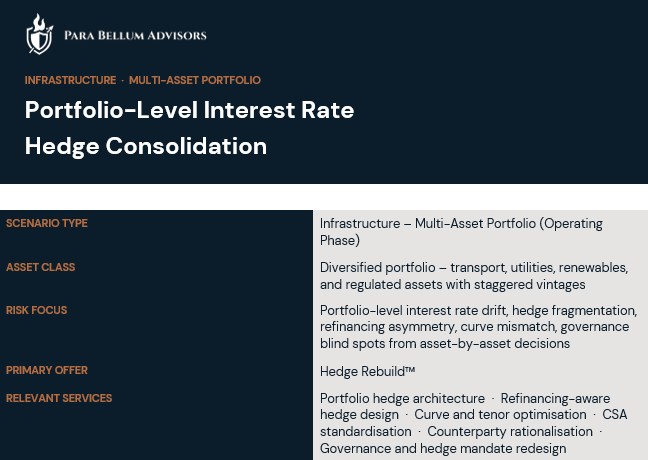
Sector: Infrastructure – Operating Assets
Asset Class: Diversified Infrastructure Portfolio (Transport, Utilities, Renewables)
Situation Type: Scaled operating platform with asset-level debt hedges accumulated across acquisition vintages
Primary Issue: Structural interest-rate and liquidity drag driven by fragmented hedge architecture – not unhedged exposure or market view
The Situation
A large infrastructure platform was built through serial acquisitions over multiple years.
Each asset was financed and hedged independently at acquisition, using vanilla interest rate swaps to stabilise funding costs.
At the time, every hedge decision was locally sensible and lender-compliant.
On paper, interest rate risk appeared conservatively managed.
In practice, the hedge book evolved into a fragmented system with no portfolio-level design authority.
As the platform scaled, the derivatives portfolio began to influence refinancing flexibility, collateral behaviour, and treasury decision-making in ways never intended at asset close.
The issue was not whether hedging worked.
It was whether the hedge architecture still functioned coherently at the platform scale.
Why This Scenario Is Common
-
Infrastructure platforms are built incrementally, not designed holistically
-
Asset-level hedges persist long after portfolio context changes
-
No single owner is accountable for aggregate rate exposure
-
CSAs and counterparties accumulate without netting logic
-
Refinancing decisions inherit legacy derivative constraints
-
Fragmentation grows quietly while everything still appears “hedged”
This is architectural drift, not risk failure.
Why It Matters
When hedge architecture fragments at portfolio scale:
-
Interest expense behaves unpredictably despite stable rates
-
Collateral becomes gross and path-dependent rather than net
-
Counterparty exposure increases without visibility
-
Refinancing is driven by derivative constraints, not asset fundamentals
-
Treasury effort shifts from control to firefighting
-
Capital efficiency degrades without breaching any limits
Nothing breaks. Flexibility simply disappears.
How This Is Typically Addressed
-
Managing each hedge issue asset-by-asset
-
Accepting collateral drag as operational noise
-
Rolling legacy swaps forward at refinancing
-
Adding short-term liquidity buffers rather than fixing the structure
-
Deferring action until constraints become binding
These responses preserve compliance, not control.
Primary Engagement Route
Primary Offer: Hedge Rebuild™ – Portfolio-Level Interest Rate Structuring
Centralisation of external hedges, CSA redesign, counterparty rationalisation, and refinancing-aware hedge architecture – preserving embedded value while restoring portfolio-level coherence.
Full structural narrative shared selectively on request.
Illustrative scenario for discussion purposes only. Not a transaction summary or client-specific case study.