
By Mike Duncan | January 2026
When refinancing optionality exists on paper but cannot be exercised safely.
Sector: Infrastructure – Regulated Networks
Asset Class: Operating Utilities & Essential Infrastructure
Situation Type: Callable public debt paired with terminating interest-rate swap overlays
Primary Issue: Refinancing optionality rendered unusable by swap termination asymmetry, liquidity exposure, and governance constraints – not funding access or rate levels
The Situation
The portfolio holds long-dated callable public debt synthetically transformed using interest-rate swaps.
On paper, the structure provides refinancing flexibility if rates fall.
In practice, exercising the call forces immediate hedge termination under compressed timelines.
As call windows approach, swap mark-to-market dominates the economics of the decision. Liquidity, collateral, and accounting implications surface simultaneously, leaving boards to assess refinancing under time pressure with incomplete control.
The issue is not whether refinancing could be attractive.
It is whether the organisation can exercise the call without triggering uncontrolled hedge settlements or governance failure.
Why This Scenario Is Common
-
Callable debt is issued to preserve long-term flexibility
-
Swap overlays are executed independently of call mechanics
-
Termination asymmetry is treated as “standard documentation”
-
No operational framework exists for exercising the call
-
Governance attention arrives only as call dates approach
The option exists legally, but not operationally.
Why It Matters
When call optionality is structurally constrained:
-
Swap MTM overrides refinancing economics
-
Liquidity pressure emerges during notice periods
-
Hedge accounting and audit considerations become gating items
-
Boards are forced into binary decisions under deadline pressure
-
Callable options decay without ever being exercised
Nothing breaks mechanically. Optionality simply becomes unusable.
How This Is Typically Addressed
-
Treating the call as a pure rate-view decision
-
Deferring consideration until call windows open
-
Accepting hedge termination as unavoidable
-
Relying on ad-hoc liquidity buffers
-
Abandoning refinancing due to execution risk
These approaches preserve form, not control.
Primary Engagement Route
Primary Offer: Structuring-as-a-Service
Callable debt and hedge coordination – aligning swap behaviour, liquidity, and governance so refinancing decisions remain executable.
Secondary / Bespoke:
Callable swap restructuring, swaption overlays, refinancing decision frameworks, and hedge-accounting support.
Full structural narrative shared selectively on request.
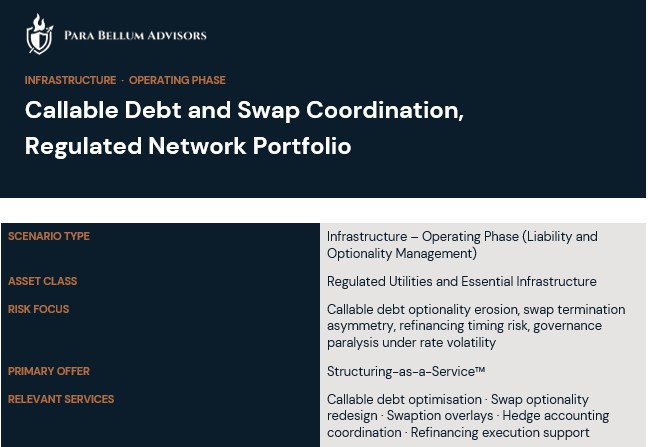
Illustrative scenario for discussion purposes only. Not a transaction summary or client-specific case study.