
By Mike Duncan | January 2026
When derivatives performance scales, but collateral economics fail to keep up.
Sector: Asset Management – UCITS / Global Macro
Asset Class: OTC Derivatives (Rates, FX, Equity Index, Commodities)
Situation Type: Scaled derivatives programme operating under legacy ISDA/CSA terms
Primary Issue: Structural capital drag from asymmetrical CSA economics, excess margin posting, and ungoverned collateral behaviour
The Situation
A UCITS global macro fund scaled rapidly across counterparties, products, and gross notional.
Trading performance remained strong. Strategy execution was not in question.
What did not scale was the collateral framework governing that activity.
ISDAs and CSAs negotiated at launch – when volumes were small and leverage limited – remained in place as the derivatives book grew into an institutional-scale programme.
On paper, the fund performed. In practice, margin mechanics quietly taxed returns and tied up capital.
Why This Scenario Is Common
-
ISDA and CSA terms are often negotiated once, then treated as static infrastructure
-
Early-stage “market standard” terms persist long after bargaining power shifts
-
Margin behaviour is viewed as operational, not economic
-
Governance focuses on trading performance, not collateral behaviour
-
No benchmark exists for “what good looks like” at current wallet size
This is not negligence. It is structural drift created by scale.
Why It Matters
As the programme grows:
-
Excess cash becomes trapped as variation and initial margin
-
Threshold asymmetry forces one-way collateral posting
-
Daily margin calls create persistent idle liquidity buffers
-
Cash collateral earns sub-economic or negative carry
-
Performance drag compounds without visibility
The strategy delivers alpha. Collateral quietly absorbs it.
How This Is Typically Addressed
-
Treating CSA terms as legal documents, not funding instruments
-
Accepting margin drag as an unavoidable cost of trading
-
One-off renegotiations without ongoing governance
-
Holding excess cash buffers “just in case”
-
Focusing on trading returns while ignoring balance-sheet leakage
These approaches preserve access – but allow drag to persist.
Primary Engagement Route
Primary Offer: Capital Efficiency Rebuild™
CSA economics review, collateral drag mapping, benchmark framework, renegotiation strategy, and governance controls.
Secondary / Bespoke:
Counterparty consolidation planning, CSA amendment support (alongside client counsel), collateral eligibility redesign, reporting and governance build-out.
Full structural narrative shared selectively on request.
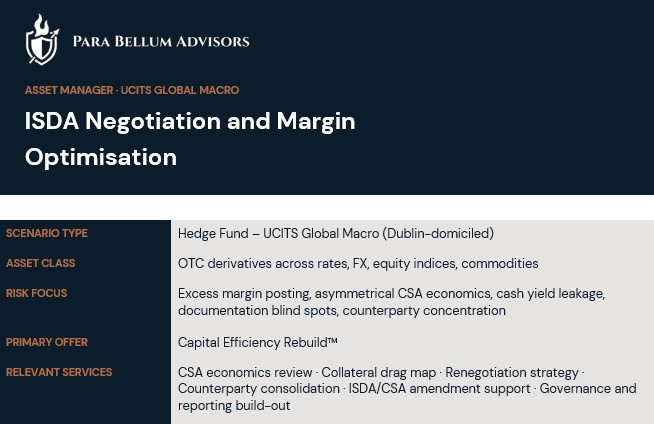
Illustrative scenario for discussion purposes only. Not a transaction summary or client-specific case study.