
By Mike Duncan | January 2026
When an index hedge stays static while the portfolio it is meant to protect moves on.
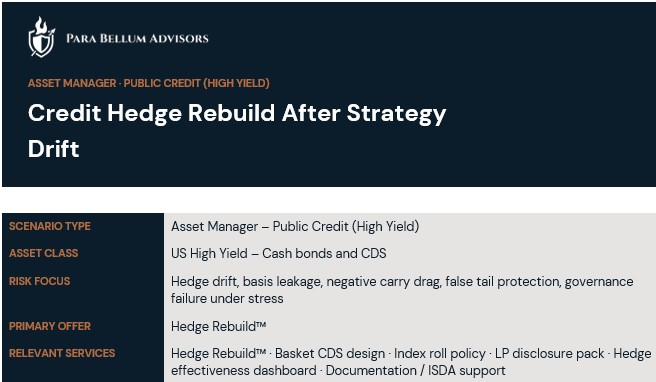
Sector: Asset Management – Public Credit
Asset Class: High Yield Credit (Cash Bonds + CDS)
Situation Type: Legacy index-based credit hedge maintained while portfolio composition evolves materially
Primary Issue: Hedge drift driven by issuer, sector, and vintage misalignment, converting intended protection into negative carry and false downside insurance
The Situation
An actively managed high-yield credit portfolio evolved over time through issuer rotation, sector reweighting, and increased concentration in high-conviction names.
A CDX HY hedge had been implemented during an earlier stress period and retained as a standing risk control. While the portfolio continued to change by design, the hedge structure remained static.
On paper, the portfolio remained “hedged.” In practice, the hedge increasingly described the index rather than the portfolio.
The protection still existed. Its relevance quietly deteriorated.
Why This Scenario Is Common
-
Index hedges are easy to implement and easy to leave in place
-
Portfolio evolution is gradual and rarely triggers formal hedge review
-
Governance focuses on hedge presence rather than hedge relevance
-
Carry costs are absorbed as part of portfolio performance
-
No single event forces reassessment until protection fails to respond
The drift accumulates silently – until it matters.
Why It Matters
As portfolio composition diverges from the index:
-
Issuer-specific losses dominate drawdowns
-
Index hedges respond weakly or not at all
-
Hedge premiums continue to be paid in full
-
Carry costs rise without commensurate protection
-
Risk discussions rely on assumptions rather than evidence
The hedge remains visible. The risk it protects against no longer is.
How This Is Typically Addressed
-
Rolling the same index hedge forward
-
Resizing notional without reassessing relevance
-
Accepting carry as the cost of “having protection”
-
Treating hedge drift as unavoidable
-
Deferring action until a stress event exposes the gap
These approaches preserve familiarity – and entrench misalignment.
Primary Engagement Route
Primary Offer: Hedge Rebuild™
Credit hedge diagnostic and redesign – issuer mapping, sector alignment, basis analysis, premium economics, and drift governance.
Secondary / Bespoke:
Execution support, documentation alignment, LP disclosure support, and ongoing hedge-effectiveness monitoring frameworks.
Full structural narrative shared selectively on request.
Illustrative scenario for discussion purposes only. Not a transaction summary or client-specific case study.