
By Mike Duncan | January 2026
When financing looks stable on paper, but compounds return drag through pricing inertia.
Sector: Asset Management – Equity Hedge Funds
Asset Class: Public Equities (Synthetic exposure via Total Return Swaps)
Situation Type: Multi-prime TRS financing programme with annual renewals and informal pricing governance
Primary Issue: Silent financing spread creep converting benign counterparty relationships into persistent structural return drag
The Situation
A mature equity hedge fund operates a multi-prime TRS financing structure supporting a scalable long-short equity portfolio.
The programme is operationally sound. Counterparty risk is diversified. There is no market stress, no execution breakdown, and no prime broker failure.
On paper, financing remains “market.” In practice, annual renewals, fragmented wallet share, and relationship-led pricing reviews have allowed spreads to drift incrementally off-market.
The structure still works. The economics don’t.
Why This Scenario Is Common
-
TRS financing is typically reviewed incrementally, not structurally
-
Annual renewals introduce small spread increases that compound over time
-
“Relationship value” substitutes for evidence-based benchmarking
-
Wallet share is fragmented, weakening negotiating leverage
- Switching risk becomes non-credible in broker pricing models
The issue develops gradually and is masked by portfolio growth and stable NAV.
This is pricing inertia, not a failure.
Why It Matters
As financing spreads creep:
- Returns are diluted without any change in strategy, skill, or market conditions.
-
Small increases compound into material return drag
-
Financing costs are absorbed as % of NAV, obscuring unit-cost deterioration
-
Peers price tighter despite similar risk profiles
-
The fund becomes classified as a “sticky” client in broker models
- Future repricing or switching becomes harder, not easier
Value leaks without a visible trigger.
How This Is Typically Addressed
-
Accepting renewal quotes as “within range”
-
Relying on relationship strength rather than live benchmarks
-
Avoiding wallet concentration to preserve optionality
-
Treating financing as background infrastructure, not a governed capital input
- Deferring action until performance pressure forces scrutiny
These approaches preserve stability – but entrench drift.
Primary Engagement Route
Primary Offer: Capital Efficiency Rebuild™ – Focused review of TRS financing economics, pricing tiers, wallet-share dynamics, and pricing governance gaps.
Optional Extension: Structuring-as-a-Service™ – Ongoing financing governance, repricing discipline, and monitoring framework (separate mandate).
Full structural narrative shared selectively on request.
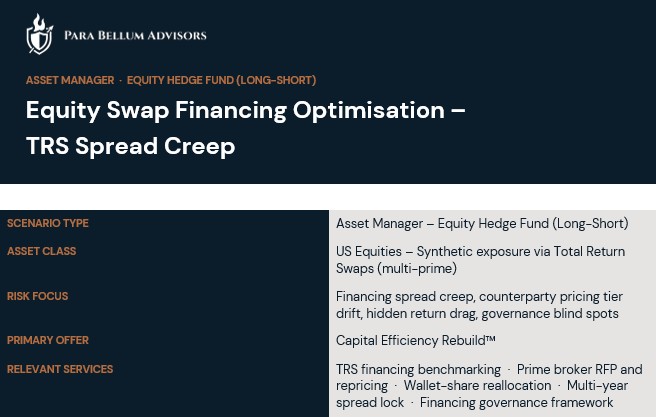
Illustrative scenario for discussion purposes only. Not a transaction summary or client-specific case study.