
By Mike Duncan | January 2026
When ESG pricing improves debt economics, but legacy hedges quietly absorb the benefit.
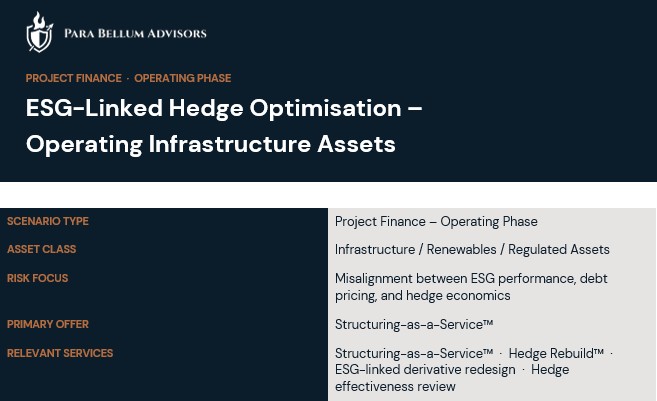
Sector: Project Finance – Operating Assets
Asset Class: Infrastructure / Renewables / Regulated Assets
Situation Type: Operating assets with ESG-linked debt pricing layered onto legacy vanilla interest-rate hedges
Primary Issue: Structural misalignment between ESG-linked debt economics and static hedge construction, causing basis leakage, accounting strain, and uncaptured value
The Situation
A mature operating infrastructure asset introduced ESG-linked pricing into its debt structure after financial close.
Asset performance is stable. ESG targets are consistently met. Refinancing economics are otherwise attractive.
On paper, the liability stack remains “fully hedged.”
In practice, the hedge framework was designed for static margin economics and does not respond to ESG-driven variability in debt pricing.
The result is a growing disconnect between debt economics and hedge cashflows.
Why This Scenario Is Common
-
ESG-linked pricing is frequently introduced post-close, after hedges are already in place
-
Legacy vanilla swaps are not designed to absorb margin variability
-
Hedge documentation assumes fixed margin economics
-
Responsibility for ESG pricing, hedging, and accounting sits across separate teams
-
The issue emerges gradually and is masked by a “fully hedged” status
This is a structural lag, not a mistake.
Why It Matters
As ESG-linked margin adjustments improve debt pricing:
-
Hedge cashflows remain fixed and blind to ESG performance
-
Basis leakage accumulates quietly
-
All-in funding costs drift away from peers
-
Hedge accounting and IC explanations become harder to defend
-
Refinancing or exit optionality becomes constrained
Value is lost without any deterioration in asset performance.
How This Is Typically Addressed
-
Treating the issue as a documentation or execution problem
-
Leaving legacy hedges untouched to avoid accounting disruption
-
Accepting persistent basis leakage as “immaterial”
-
Deferring action until refinancing forces a reset
These approaches preserve optics but allow value leakage to continue.
Primary Engagement Route
Primary Offer: Structuring-as-a-Service™ ESG-linked hedge and liability alignment design, preserving embedded hedge value while restoring economic coherence.
Full structural narrative shared selectively on request.
Illustrative scenario for discussion purposes only. Not a transaction summary or client-specific case study.